Showing posts with label book. Show all posts

Thursday, 6 February 2025

Review of Nigel Smith's "The Honvéd War"

[First published 6 February 2025; updated 27 February 2025.]


Regular readers of this blog will know that the Hungarian War of Independence is one of my particular enthusiasms. Decent English-language sources on the military history of this substantial war are few and far between. I am therefore very pleased to report on an important addition to this underserved bookshelf: The Honvéd War: Armies of the Hungarian War of Independence 1848-49, by Nigel James Smith, which was published by Helion in 2024.

Thank you, Santa!

(Let me preface this book review with a disclaimer. Nigel and I are both Helion authors; I gave Nigel some minor assistance with the preparation of his book and he kindly acknowledges me in it. Furthermore, I have met him once and I owe him a drink. That said, I was already in his debt because of his previous visit to 1848 in his work published by Pickelhaube Press in 2006, The Magyar War, which I had found very useful and full of information that was difficult to obtain from anywhere else.)

Anyway, to business:

For £29.95 you get over 200 pages of nicely produced book on glossy paper that enables a gallery section in beautiful colour, as well as dozens of rare black-and-white illustrations scattered throughout the text.

Of those 200 pages:

- 20 are devoted to the history of the war;

- 60 pp to the organisation, weapons and tactics of the three armies involved;

- 9 pp to ten of the most important generals;

- 73 pp to uniforms and flags (including 14 colour plates);

- 29 pp to historical orders of battle.

The history section is nicely written and does a good job of explaining the course of this complicated war. Perhaps my favourite part is where Smith describes how "Jellačić, in his capacity as [Kaiser Ferdinand's] Croatian Viceroy, on behalf of King Ferdinand of Croatia pronounced a declaration of war against King Ferdinand V of Hungary. Astute readers will have noted that this Kaiser and both these Kings were one and the same man." It might have benefited from a couple more maps or, at least, having the major battles marked on the one map on p12. However, the campaign history is not the main focus of this work, so this is a minor complaint. (In fact, for readers who already have the complementary campaign histories published by Helion, it minimises redundant overlap.) One tiny quibble: it was not Windischgrätz but his subordinate, Jellačić, who defeated Perczel at the battle of Mór.

Perhaps inevitably, the text displays some inconsistencies in the spelling of eastern European place names, etc. In particular, Smith uses an idiosyncratic spelling, "Széklars", for the Transylvanian people known in Hungarian as Székelyek or conventionally in English as "Szeklers". However, these are cosmetic problems rather than being likely to cause any real confusion.

The sections on organisation, weapons and tactics are comprehensive, thorough, and full of detail. This ranges from corps structure and offensive artillery doctrine down to small unit tactics. There is a lot of dense information here but it is conveyed in a clear and readable manner that helps us to understand the character of each army and how it operated. E.g., of the Russian army, Smith says, "obedience was literally beaten into the rank and file".

In the earlier version of this review, I expressed some mild regret that, for all its comprehensive coverage, The Honvéd War didn't provide information on a couple of obscure Imperial units I'd struggled to identify during my own researches: Cordonisten and National-Uhlanen. It is a tribute to Nigel's research skills - and therefore further assurance of the quality of this book - that he has since tracked down and sent me detailed information on the two Cordonisten battalions, including their combat history during 1848-1849, their uniforms, and even their commanders' names. Much obliged!

Smith's brief biographies of the main commanders are clear and informative and give us pen portraits of some colourful characters such as the "Hyena of Brescia", "Papa Bem", etc. (Though I might question his statement that Richard Debaufre Guyon subsequently "served the Ottoman Army with distinction against the Russian Army in Asia Minor": as Zarif Pasha's chief of staff during the Crimean War, he devised a plan that might have worked for the honvéd but was too sophisticated for the Ottoman army of the Caucasus, which was consequently destroyed in the battle of Kurudere.)

A third of the book is given over to uniforms and flags. This is truly exhaustive and has all you could possibly need on this topic. As well as everything you'd expect concerning types of headgear, the colours of tunics and buttons, or the hues of regimental facings, we learn about such things as linen recognition strips tied to Austrian shakos to tell friend from foe, or Polish konfederatki caps being worn both with and without peaks. The colour plates are a good mix of old prints or paintings and original new artwork. I particularly like the Imperial grenadier in his splendid M1836 bearskin.

The 'Orders of Battle' section provides detailed snapshots of the composition and structure of the major formations at several pivotal junctures in the course of the war. Smith's footnotes demonstrate that he has not simply reproduced these from other sources but has examined them critically to check their accuracy.

My few criticisms above do not materially detract from the work and are offered mainly to show that this is a thorough and unbiased review by a reasonably qualified reviewer. The fact that they are all so minor also proves that this is a very good, well-researched book by a skilled and knowledgeable author. It will be invaluable to any wargamer or military modeller seeking to portray this fascinating conflict. Essential reading if you want your tabletop armies for 1848 to be properly organised and look authentic. Excellent value and highly recommended!


PS - I cannot avoid some self-promotion here. Anyone who has read this far is surely sufficiently interested in this war that I should mention my own related publications (in case you don't already know about them). These include three translated histories and one wargames campaign book:

Hungary 1848: The Winter Campaign

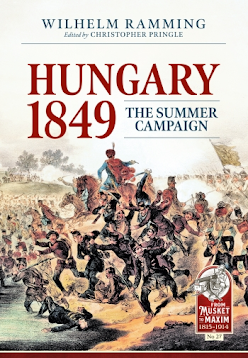
Hungary 1849: The Summer Campaign

The Hungarian War of Independence 1848-1849: an illustrated military history (forthcoming 2025)

Bloody Big HUNGARY '48 Battles!


Friday, 14 April 2023

"Hungary 1849" reviewed: "a cracking read"!

I was delighted today to see the first review of my recently published book, "Hungary 1849: The Summer Campaign". I am obliged to Colin Ashton for reviewing it on his "Carryings On Up The Dale" blog, here.

Colin gave a very generous review to the previous volume, "Hungary 1848: The Winter Campaign". This time he is equally kind. Phrases like "Chris Pringle has again done a superb job" and "a sympathetic translation, forensically researched and presented, and a cracking read to boot!" are calculated to warm any author's heart. (As is giving it five stars on Amazon - thanks, Colin.)

I hope I might have a chance at some wargame show or other such event to express my appreciation to Colin in person, but for now let me publicly thank him here.

Saturday, 21 January 2023

Newly published: "Hungary 1849: The Summer Campaign"

I am delighted to report that my latest book was published this week. "Hungary 1849: The Summer Campaign" is the sequel to "Hungary 1848: The Winter Campaign". Together, these two volumes provide a complete and very detailed military history of this epic year-long struggle.


The previous volume has had some very kind reviews, e.g.:

- by "Balkan Dave" Watson

- by Colin "Carryings on up the dale" Ashton

- by Mike Huston on "Hamsterwrangler"

and others. I hope "Hungary 1849" will be equally well received.

As this blog is mainly aimed at wargamers, let me remind you that, if you want to wargame the battles described in these books, scenarios for 16 of the most important ones are to be found in my BBB campaign supplement for this war, "Bloody Big Hungary '48 Battles!".


Tuesday, 16 August 2022

JMH on Clausewitz 1799: "finely translated, annotated, and edited volumes"

Just over a year ago, Professor Nicholas Murray and I published translations of two more volumes of Clausewitz's histories which helped him develop his theories:

"Napoleon Absent, Coalition Ascendant: The 1799 Campaign in Italy and Switzerland, Volume 1"

"The Coalition Crumbles, Napoleon Returns: The 1799 Campaign in Italy and Switzerland, Volume 2"

These have now been very positively reviewed in the Journal of Military History, Vol.86, No.3, July 2022. JMH's reviewer, Professor Frederick C. Schneid, is kind enough to say Nick and I "continue to produce finely translated, annotated and edited volumes of Carl von Clausewitz's military histories" and "For those scholars who study this era, these volumes will be a wonderful addition to their library". He also mentions our previous volume, "Napoleon's 1796 Italian Campaign", describing it as "clear, well-presented, and valuable".

I am very grateful to Professor Schneid for his review.

Thursday, 7 July 2022

Newly published: "Bloody Big Battles in INDIA!"

I am delighted to announce the publication of the third BBB campaign supplement: "Bloody Big Battles in INDIA!" (BBBI), by Dr Mark Smith. This covers the Second Maratha War (1803-1806) where Wellington made his name; the Gwalior campaign of 1843; the Sikh Wars; and the Indian Mutiny.

From helping Mark to playtest these sixteen scenarios, I can report that they are super games. The asymmetrical armies make for interesting tactical challenges (how best to use camel-mounted rockets ... ?). So too do the situations, e.g., protecting baggage against marauding cavalry, or the unusual cityfight in Lucknow. Furthermore, Mark writes very nice clean unfussy scenarios with well-designed objectives. I've provided the full back cover 'blurb' and a list of the battles included at the foot of this post. To get a flavour of the scenarios in the book, here are a few battle reports: Delhi (1803); Argaum (1803); Laswari (1803); Maharajpore (1843); Punniar (1843); Aliwal (1846).

The book is published by SkirmishCampaigns. It should be available from all SC's usual retailers shortly - shipping out this week or next, I think - but let me give a special shout out to North Star Military Figures, who snapped up a big order within 30 seconds of hearing about BBBI! (At time of writing, not yet listed on their website, but drop them a line if you want a copy.) BBBI joins the two existing BBB campaign supplements: "Bloody Big EUROPEAN Battles!" (BBEB) and "Bloody Big BALKAN Battles!" (BBBB). The fourth is in press and will appear later this year: "Bloody Big HUNGARY '48 Battles!" (BBHB). A couple more collections are in fairly advanced preparation as well, so expect more BBB books in 2023.

Thank you to everyone involved: Mark for all his hard work and skill in creating such a fine collection and introducing me to these wars about which I knew very little; our merry group of playtesters at OWS; Scott at SkirmishCampaigns; all the retailers who carry the BBB books; and, of course, the 1,000s of you out there who read this blog, or are members of the BBB group or Facebook page, and whose shared enthusiasm for this period is what really keeps the BBB project going.

===

[From the back cover of BBBI]

The major states of India, especially the Maratha Confederacy and the Sikh state in the Punjab, were among the most redoubtable opponents of the extension of British power in the sub-continent. The size and technological sophistication of their forces posed major problems for East India Company commanders in the field and frequently threatened them with defeat. BBBI lets you refight sixteen of the most important battles of the period from the Second Maratha War (1803-1806) to the Sepoy Uprising (‘Indian Mutiny’) of 1857-1858. This collection gives you:

·       The battles where Wellington made his name!

·       A wide range of terrain and tactical situations!

·       Balanced scenarios with asymmetrical armies!

·       Unusual troops – Gurkhas, camel rockets, ghazis!

·       An engaging game of constant decision-making!

·       Battles you can fight to the finish in an evening!

Many also offer scenario options to explore ‘what-ifs’ and increase replay value. Campaign options allow players to link battles so that each has consequences for the next.

===

Battles covered:


The Second Maratha War (1803-1806) – 4-scenario mini-campaign

    Delhi

    Assaye

    Laswari

    Argaum

The Gwalior War (1843) – two individual scenarios

    Punniar

    Maharajpore

The First Sikh War (1845-1846) – 4-scenario mini-campaign

    Mudki

    Ferozeshah

    Aliwal

    Sabraon

The Second Sikh War (1848-1849) – 3-scenario mini-campaign

    Kyneerie

    Chillianwallah

    Gujrat

The Sepoy Uprising (‘Indian Mutiny’) (1857-1859) – 3-scenario mini-campaign

    Second Battle of Lucknow

    Third Battle of Lucknow

    Bareilly


Update 31 March 2023: the fine French wargames magazine Vae Victis has devoted almost a whole page to a nice positive review of BBBI. (Issue No. 167, March/April 2023.) VV's verdict: "Like all the BBB supplements, the content is extremely informative and, in the present case, enables you to recreate some very unusual and colourful battles." Merci, Nicolas!


Tuesday, 24 May 2022

The Unluckiest All Black

Surely all wargamers and amateur military historians enjoy reading about the deeds of braver and better men than ourselves. In that vein, let me depart from this blog's usual military scope and pay tribute to an illustrious forebear whose notable exploits were performed on the rugby pitch rather than the battlefield (his military service being on the home front).

Alexander 'Nugget' Pringle (1899-1973) played rugby for New Zealand, earning one All Black cap in 1923. He would surely have merited more, but fickle fate in the form of injury, illness or other misfortune thwarted him repeatedly - hence the title of his newly published biography, 'The Unluckiest All Black'. This is available in paperback for a modest £9.95 or as an ebook, eg on Kindle for just £4.99. It has been described as 'the latest addition to the New Zealand rugby canon' by noted author and historian, Dr Ron Palenski, who kindly provided invaluable assistance during preparation of the book.* I hope it will be of interest to some readers of this blog.

(Disclaimer: I helped prepare the book too, mainly with the graphics.)

* Incidentally, as well as his sports books, Dr Palenski is an authority in our usual military history domain as well. His military books include 'Kiwi Battlefields' and 'Men of Valour: New Zealand and the Battle for Crete.

Wednesday, 2 March 2022

"The face for radio, but not the voice for it"

I had a new experience last month: I was interviewed for a podcast. (The tongue-in-cheek title of this post is meant to refer to me, not my handsome and mellifluous host, Scott Van Roekel.)

Scott is the creative genius behind the "Shot and Shield" podcast dedicated to 19th century and colonial tabletop wargaming. Each episode is a medley of information, ideas, interviews and entertainment geared to the interests of us C19 wargamers. Scott is a pro, it is well produced with bursts of music, audio clips of various kinds, and of course the engaging manner of the "Duke of Florida" himself. There is also a supporting Shot and Shield Podcast Wargaming Group on Facebook which is a rich resource in its own right.

Scott recently interviewed Dr Chris Brice. Chris is series editor of the "Musket to Maxim" books published by Helion, not to mention author of several books of his own. The resulting Shot and Shield Supercast 31 focusing on "Forgotten Victorian Generals" is well worth a listen.

Scott also asked Chris to offer authors of other books in the series for interview. I am honoured to have been the first up after Chris. Shot and Shield Supercast 32 includes a long conversation between Scott and me (starting about 25 minutes in). It hangs on the hook of my book "Hungary 1848: The Winter Campaign", but really it is a wide-ranging discussion. We talked not only about events during the Hungarian revolution and war of independence, but also about the background to it, the aftermath, and ripples and echoes in other subsequent conflicts; and not only about the military aspects but also the political and diplomatic dimensions, some insights into the characters involved, etc. Scott had scheduled an hour for our call but we ended up talking for a good 90 minutes plus - don't worry, he's edited it down! - but that tells you we had a lot of fun doing it, and I think that comes through in the podcast.

Regular readers of this blog may well feel they already know more than they ever wanted to about Hungary 1848. In that case, by all means skip the interview with me - but I do encourage you to sample other episodes. If you need something to listen to while you're painting figures, or on your commute, or whatever - give "Shot and Shield" a go!

Wednesday, 14 April 2021

Newly published: "Hungary 1848: The Winter Campaign"

I am delighted to record that my book "Hungary 1848: The Winter Campaign" was published today.

I believe this fills an important gap in the English-language literature on a major conflict that deserves to be better known. I hope readers will judge my efforts kindly.

As an indication of what the book's 371 pages contain, here is a sample map (no, the red panels aren't part of it, I've added them to highlight its key features) followed by the table of contents:

Map 3a: Hunting Görgei, hunting Schlick, December 1848 to late January 1849


Contents
 
List of Maps
Introduction
Acknowledgements
A Note on Wargaming Hungary, 1848-1849
Table of Place Names
The Austrian and Hungarian Armies
Prologue: Events Leading Up to the Winter Campaign
Preface by Feldmarschall Fürst Windisch-Grätz
Foreword by Feldmarschall-Lieutenant Johann Nobili
 
Chapter 1: The army’s deployment. Events from the start of operations until the imperial troops’ entry into Ofen-Pesth [Budapest]. The period from 1 November 1848 to 5 January 1849
The situation at the start of the campaign, 1 November 1848
Forces available, December 1848
Preliminary moves, 10 November to early December
Plan of operations
The advance on Pressburg, 16-23 December
Simunich takes Tyrnau, 14-22 December
The advance on Raab, 23-28 December
The plan for the advance on Ofen-Pesth
The flanking detachments’ actions during December
The action at Moór, 30 December 1848
The investment of Komorn, 29-31 December
The march to Ofen, 1-4 January 1849
The occupation of Ofen-Pesth, 5 January 1849
Schlick’s corps musters in Galicia, 5 November to 1 December 1848
Schlick crosses the Carpathians and occupies Kaschau, 5-11 January 1849
From the occupation of Kaschau to the battle of Kaschau, 11 December 1848 to 7 January 1849
 
Chapter 2: Events from the occupation of Ofen-Pesth until after the battle of Kápolna. The period from 6 January to the beginning of March 1849
The situation after the occupation of Ofen-Pesth, 6 January 1849
Wrbna takes Waitzen, 7 January
Ottinger takes Szolnok, 13 January
Rear security and the Mining Towns, 30 December 1848 to 10 January 1849
Csorich hunts Görgei in vain, 10-15 January
Concern for Simunich and Neustädter, 13-14 January
The Feldmarschall orchestrates Simunich, Neustädter and Csorich and reinforces Schlick, 16-21 January
Görgei eludes Csorich, 17-22 January
Events in the rear and on the Theiss, 13 January to 1 February
Csorich takes Schemnitz and returns to Pesth, 20-29 January
Miscellaneous troop movements, 25-30 January
The general situation at the end of January 1849
Schlick’s operation against Tokay, 19 January to 1 February
Events around Leopoldstadt, Komorn, and rear areas, 31 January to 9 February
Events in the south, 30 January to 20 February
Events on the middle Theiss, 1-12 February
Upper Hungary: Görgei escapes the trap; Schlick eludes Görgei, 29 January to 29 February
The lead-up to Kápolna: co-ordinating with Schlick, 15-24 February
The lead-up to Kápolna: covering the right flank, 15-24 February
Final prelude to Kápolna, 25 February
The battle of Kápolna: the first day, 26 February 1849
The battle of Kápolna: The second day, 27 February 1849
Aftermath of Kápolna: pursuit to Mezö-Kövesd, 28 February to 1 March
The Hungarian army escapes through Poroszló, 1-2 March
The imperial army shifts back to the middle Theiss, 3-7 March
 
Chapter 3: From the start of the army’s concentration on the middle Theiss between Szolnok and Pesth until the recall of Feldmarschall Fürst zu Windisch-Grätz from the army high command. The period from the beginning of March to 14 April 1849
I. Armeekorps is driven out of Szolnok, 5 March
The Hungarians avoid being counter-attacked at Szolnok, 6-10 March
The imperial army shifts southward and reorganizes, 10-12 March
Abortive preparations for a reconnaissance in force across the Theiss, 14-17 March
The brief Hungarian foray from Czibakháza, 17-19 March
The new Hungarian plan to debouch through Poroszló
The Feldmarschall prepares to receive the new Hungarian attack, 19-25 March
Events on other fronts, 10-25 March
Hungarian plans and order of battle, 25 March
Schlick’s reconnaissance in force: The action at Hatvan, 2 April 1849
The Feldmarschall concentrates around Gödöllő, 2-4 April
The Feldmarschall’s reconnaissance toward Hatvan and the deployment at Gödöllő, 5 April
The battle of Isaszeg, 6 April 1849
The retreat to Pesth, 7 April
Hungarian forces and movements leading up to the battle of Isaszeg, 25 March to 6 April
The siege of Komorn progresses; reinforcements arrive; and events on the southern front, 29 March to 10 April
Screening Pesth 8-11 January and the action at Waitzen on 10 January
The Feldmarschall’s last plans are thwarted by his subordinates and then he is removed from command, 12-15 January
Hungarian dispositions, 7-18 April
Concluding remarks
The Feldmarschall’s farewell messages
 
Epilogue: Events on the Main Front from 15 April to the Beginning of May 1849
 
Appendices:
Appendix I: The Transylvanian Front
Appendix II: The Southern Front
Appendix III: Notes on Orders of Battle
 
Bibliography
Index


I am pleased to say that my excellent publisher has been sufficiently impressed (or at least, advance sales have been strong enough) to sign me up for the sequel: "Hungary 1849: The Summer Campaign". I have already finished the translation but still have to tackle the substantial task of creating the maps. I expect to deliver the final manuscript to Helion later this year for publication in 2022.

Finally, just a reminder of my three recently published Clausewitz translations in collaboration with Professor Murray of the US Naval War College:

Napoleon's 1796 Italian Campaign

Napoleon Absent, Coalition Ascendant: The 1799 Campaign in Italy and Switzerland, Volume 1

The Coalition Crumbles, Napoleon Returns: The 1799 Campaign in Italy and Switzerland, Volume 2


Tuesday, 29 January 2019

Al Nofi reviews Clausewitz's history of the 1796 campaign

Quite an honour to get this positive review from Al Nofi, a real luminary of military history, of wargame design, and of the serious professional conflict simulation community, on the influential StrategyPage website:
link
"Napoleon's 1796 Campaign is a valuable book for anyone with an interest in the period or in military theory, and arguably one that should be read twice".

Thursday, 25 June 2015

In praise of Helion - great for C19 books

Time to say some words in praise of Helion. No, I don't mean Poland's leading publisher of computer books, but Helion & Company, a terrific publisher of military history books, especially on the kind of neglected and obscure topics I love, and a company that gives outstanding personal service. My shelves are creaking under the weight of Helion tomes on some of my favourite conflicts: the Schleswig-Holstein Wars, Austro-Prussian, Franco-Prussian Russo-Turkish ...

This post is prompted because this week a copy of their latest publication dropped through my letterbox. The gem in question is Dusan Babac's "The Serbian Army in the Wars for Independence against Turkey 1876-1878". With my longstanding interest in nineteenth-century Balkan wars, this was a must-buy.
 

Babac provides the background history and detailed accounts of numerous Serbo-Turkish battles. He also gives exhaustive information on the Serbian army's organisation, weapons and uniforms, flags and medals. The book is absolutely bursting with illustrations, many in colour: contemporary photographs, paintings, woodcuts, as well as modern pictures. The one disappointment for me was the absence of any maps of the battles. That reservation notwithstanding, this is a really excellent book full of hard-to-find information and I consider my money well spent.

I have had a 6mm Serbian army for a long time. It hasn't had many outings. Designing a scenario for the battles around Aleksinac from the First Serbo-Turkish War has been on my agenda since before I published "Bloody Big Battles!", but I haven't quite got round to it. This book will help to change that. 


Wednesday, 11 February 2015

Baptism of Fire: The Royal Hungarian Air Force and Slovak Air Force, March 1939

While I'm in the mode of recommending friends' books, here are some more. Hungarian military history is one of my particular enthusiasms. Through this I got to know Dr Csaba Stenge. Csaba has published a lot in Hungarian, but for the purpose of this blog I'll limit myself to mentioning a couple of his works in English. He has written this nice work about Hungarian tanks (currently unavailable, I believe):

http://www.amazon.com/Magyar-Steel-Hungarian-Armour-WWII/dp/B0017TCTD4/ref=sr_1_1?ie=UTF8&qid=1423661984&sr=8-1&keywords=csaba+becze


But his real forte, the obsession to which he has dedicated a huge amount of time and effort, is the Royal Hungarian Air Force. He has personally known many of the RHAF's WWII veterans as friends, has acquired a fine collection of RHAF photos, logbooks, and other memorabilia, and is a (perhaps the?) leading expert on the RHAF.

An example of his work in English is this one, a beautifully thorough examination of a mostly forgotten corner of history:

http://www.amazon.com/Baptism-Fire-Combat-Experiences-Hungarian/dp/1906033935/ref=sr_1_3?ie=UTF8&qid=1423661757&sr=8-3&keywords=csaba+becze


Saturday, 7 February 2015

WWI recommended reading: Murray, "The Rocky Road to the Great War"

If you're interested either in the First World War, or in the late nineteenth century conflicts that preceded it, I highly recommend that you read Nick Murray's book. Nick examines how the theory and practice of fortification change in response to developments in technology and doctrine, and his insights really help the reader to understand why WWI took the shape that it did.

Disclaimer: Nick and I have been friends for many years, and I played a small role in helping him with his research that led to this book, including an eventful trip to Plevna together. If you look carefully you'll find me in one of the photos in the book.

Buy this book!

http://www.amazon.com/Rocky-Road-Great-War-ebook/dp/B00F8ZJR2E/ref=sr_1_6?ie=UTF8&qid=1423306718&sr=8-6&keywords=murray+rocky+road