Showing posts with label colonial. Show all posts

Thursday, 18 June 2026

Khartoum characters

This was a final check playtest of a scenario we first played back in 2022: Khartoum. (Report here.) Time doesn't allow me to do a very long and detailed report this time, so I just offer 16 photos with some light remarks.

General Gordon is in Khartoum. He has refused to recognise how desperate his situation is. That's right - he is in de-Nile. (Save your groans, there's worse to come.)

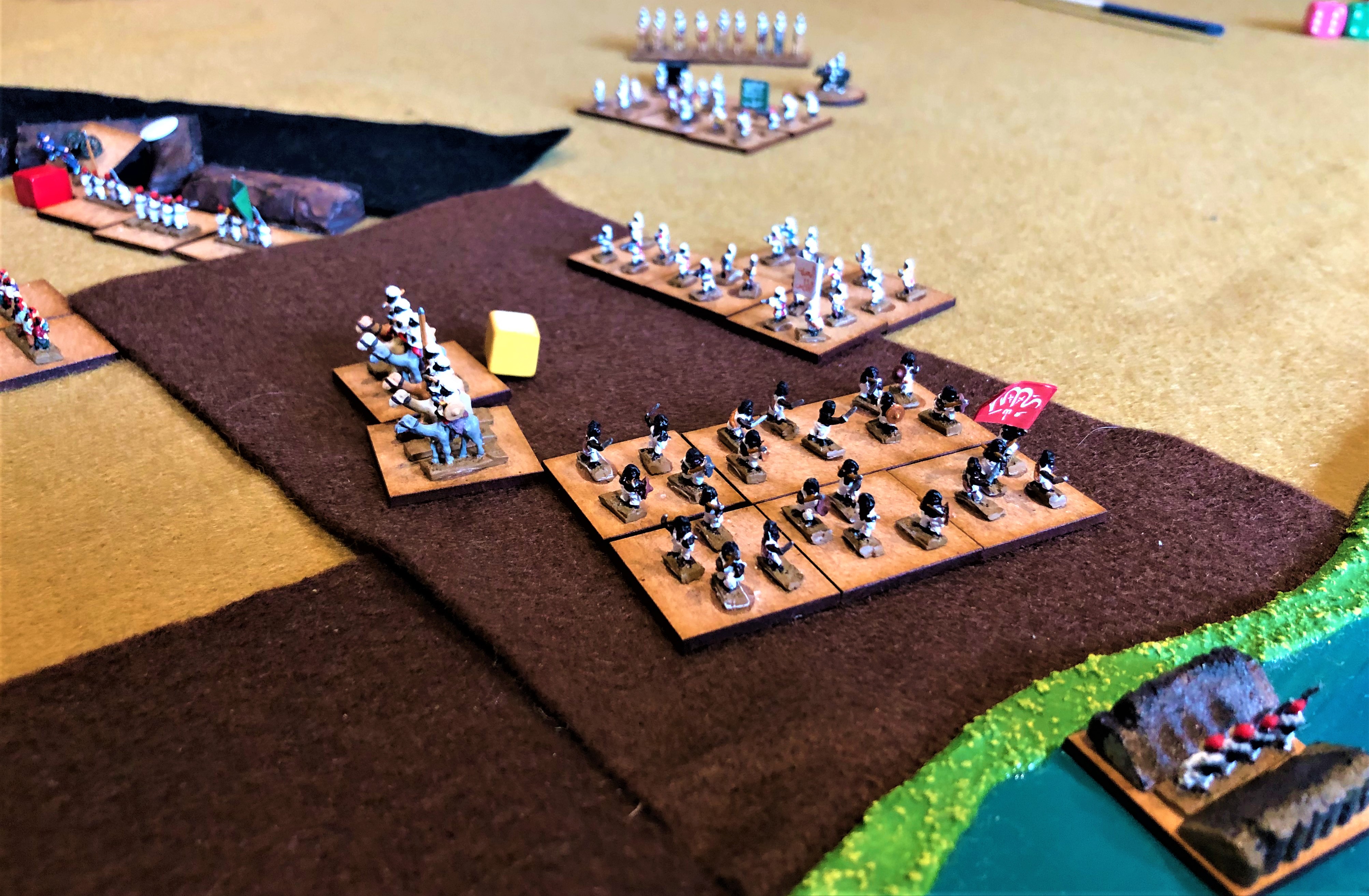
Dave T and I commanded the mad Mahdists. I had the right wing, shown here. The orange counter notes a unit of captured Egyptians forced to fight for the Mahdists. Figures are Baccus 6mm from Mark's collection.

Mahdists attack left to right. Khartoum is protected by a line of earthworks, with a belt of obstacles in front of those (the dark felt): barbed wire, broken glass, artillery shells serving as mines. Brown felt at top is where the Nile has flooded, washed away the end of the earthworks, then receded leaving a marshy gap. White counters are objectives: the artillery bastions along the fortified line; various locations in the city (forts, the cathedral, the palace, etc).

Gordon and a big Krupp gun on the roof of the palace. The paddlesteamer gunboat wrought some havoc late in the game.

Mahdist camelry.

Egyptians wait behind their earthen ramparts.

Our cunning plan was for Dave T to surge through the marshy gap. However, see that little barge moored in mid-river to flank the line? The rifle fire from there was exceedingly irksome.

I shifted my weight left from here towards the marshy end so as to marry up with Dave's push on the left. Our rifle fire was effective in the first 3 turns, wiping out a couple of the tiny Egyptian units.

We chose to take a scenario option and launch a landing force across the Nile behind the Egyptian line. Unfortunately some of our troops were slow to embark and cross. That's right - they were not well-en-dhowed. As a result, half of them never got into the fight and were just mown down by the gunboat.

However, the other half of this outflanking contingent did better - it was the only Mahdist unit to get into Khartoum. Here we see it enter the outskirts of the city, having routed some enemy irregulars.

Situation late in the game. Apart from that sole incursion into the city, the rest of Dave's force is bogged down top of pic, while my repeated attempts to storm across the ramparts have all failed and every one of my units is stuck in the obstacle belt.

Gamely our lads go in again. All these charges will likewise bounce off except for my cavalry, upper right, who will push their foes back but then be gunned down as they mill about post-melee.

Similar story for Dave's repeated charges on our left.

Gordon can't afford to get cocky, though, as Dave's city raiders work their way closer to the palace. Next turn they will overrun the palace.
That's right - Gordon and his men will be an-Nile-ated.

With a couple of turns to go, some of mine get over the ramparts at last. This prompts most of the remaining Egyptian defenders to fall back to the city, having successfully bought time.

Game end. The three units in the foreground with green cubes are mine. The one in the palace at the top is Dave's. The other four, though, are Crispin's, still hanging on in objective locations despite being low on ammo (black cubes).

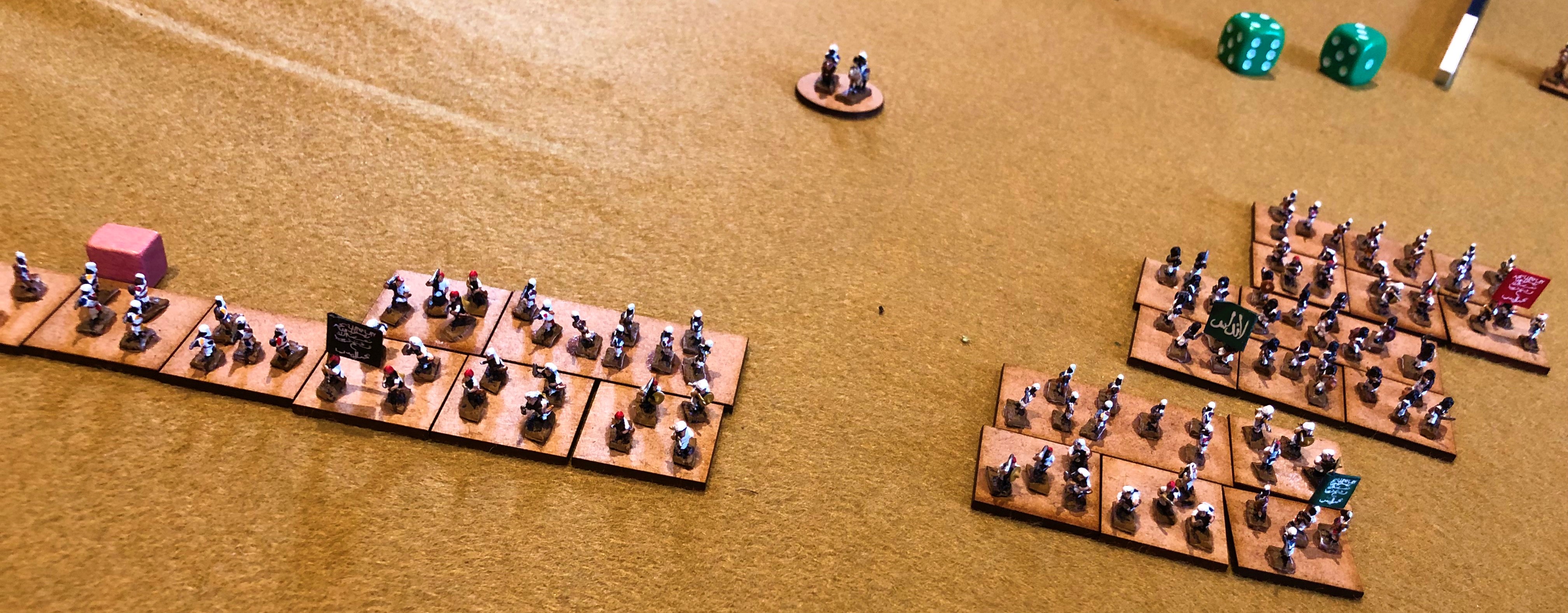
And the bigger picture shows most of Dave's force still trying to finish off one last 2-base Egyptian unit (in the foreground, with the yellow cube).

Skilful defence by Crispin denied us even a draw. We could point to some unkind dice at important times - when we launched so many charges, we could reasonably have expected more to succeed - but sometimes you just have to give credit to the opposition. Regardless, it was a good game that presented challenges and options to both sides. Different plans are possible so it has replay value.

This will be one of the battles in our planned Bloody Big Battles in Africa! scenario book that we hope to complete this year.



Thursday, 12 October 2023

Kassassin & Tel-el-Kebir (1882) as a single scenario

After last week's excursion among the sun-kissed vineyards of northern Hungary, this week we were transported to the sun-baked sands of northern Egypt. As part of the "Bloody Big AFRICAN Battles!" project, we playtested Mark's scenario for Tel-el-Kebir (1882), the major action during the British conquest of Egypt.

Tel-el-Kebir on its own is not very exciting as a situation to wargame: a frontal assault on a simple line of entrenchments that was over in an hour after a rather one-sided fight. (See my post here on whether frontally assaulting redoubts can make a good game.) Mark's creative solution was to combine it with the preceding action at Kassassin. This entailed some compression of both time and space: Kassassin should really be another four feet away from the entrenchments, rather than on the table edge; and the 'Night Interval' between the two actions is actually the fortnight between 28 August and 13 September 1882. This compression did not create any distortion or other problem and produced a scenario in which both sides get to do some maneuvering and have some genuine decisions to make.

Herewith a brief photo-AAR followed by some reflections:

It really was a very pretty table. Proper sand-coloured cloth, sandy hills, sand-embanked railway, exquisite palm trees, and a tidy British tent encampment in the foreground. The loco is pushing a flatcar-mounted 40-pdr gun. The British 2nd and 4th Brigades are all that stands between the 15,000 Egyptians debouching from their entrenchments (top of pic) and the British camp and the village of Kassassin (lower left). If either of these two objectives is taken, however briefly, the Egyptians earn a victory point - in effect, establishing a 'highwater mark'.

The open sandy plain on the British right. A small Egyptian force threatens from top right, opposed by British guns bottom left. Just visible at top of pic, to the left of the QR sheet, is pale felt representing the soft sand ('Difficult Terrain') protecting the Egyptian lines' left flank.

The Egyptian assault inflicted casualties (you can see both British 3-base infantry units are now reduced to 2-base) and came close to breaking through and taking the camp. However, the thin red line held firm long enough for the Household Cavalry to come to the rescue (upper right), to be followed on Turn 3 by the Guards Brigade. Egyptian losses were heavier (blue cube indicates a Spent unit; another brigade was wiped out entirely). The scenario gives the Egyptian player the option of pressing his attack for 4 turns rather than 3, which has two advantages: it not only gives another bite at the cherry to take the camp or Kassassin, it also means the British player will have one turn less when it comes to assaulting the entrenchments. However, Mark opted not to take the extra turn, preferring to have his troops spend it defending entrenchments rather than being ridden down by Horse Guards in the open.

Cavalry action on the British right. I sent the Indian cavalry brigade (top left of pic) through the gap between the two advancing Egyptian contingents and then wheeled it right to take on its Egyptian counterparts (right foreground). This put it in a crossfire from Egyptian guns, not to mention an infantry brigade. Fortunately, my enfilading artillery helped to wipe out the infantry. Still, I was lucky not to lose the Indian horse entirely. Don't give me cavalry to command, I clearly don't know how to use them.

I only took photos of the first third of the game, so apologies that you will have to make do with my 1,000 words to paint a picture of the rest of it. Having repulsed the Egyptians from Kassassin, I needed to take 5 of the 9 remaining objectives to win. Two of these were villages among the palm groves and farms south of the canal (top left in first pic), the other seven being redoubts dotted among the entrenchments (all marked by white counters in first pic). In the Night Interval, my troops set up in the historical deployment for the assault on Tel-el-Kebir: Indian brigade on my left south of the canal; Highland Bde and 4th Bde north of it; a grand battery in the centre; 2nd Bde and Guards Bde on the right; Cavalry Division on the right flank.

Honestly, I found the prospect of assaulting the Egyptian fortifications daunting. Most of the Egyptian troops had modern breechloading rifles, with long effective range and deadly short range; they also had a lot of Krupp breechloading cannon, which are no fun to assault frontally. I was especially concerned about the risk to my cavalry (the BBB rules make them a more vulnerable target than infantry) so I fannied about trying to hide them initially, rather than using them to outflank or assault.

Still, I got stuck in eventually. On the left, the Indians took one objective village but ran out of time to reach the second. Next along, the Highlanders and 4th Bde took a long time to storm one objective redoubt, so although they then had another at their mercy, they only had one turn left to take it and failed the movement roll to do so. On my right, the Guards and the Household Cavalry broke in and took one redoubt; the HC were so successful they had a compulsory exploit that actually put them in a position where they had a chance at taking another redoubt in the second line of entrenchments, but didn't quite manage it; redoubts to right and left of the Guards' incursion were at risk on the last turn, but all my three units in range failed to get the necessary movement rolls.

Thus, I took 3 objectives, and had chances at 5 others on the last turn. As none of these came off, I was left with a defeat, but it was by no means a crushing one-sided one, as victory had been very much a possibility until those last few dice. It was a thoroughly entertaining game and should go down well when Mark takes it to the club.


Reflections:

Too much artillery. The typical BBB figure ratios are either 1,000 men / 24 guns per base or 1,500 men / 36 guns per base. For this scenario, Mark had used 500 men / 6 guns per base. That meant artillery was 100% overrepresented - no wonder I was daunted! It evened out to some extent, of course, because the British have plenty of artillery too, but it advantaged the Egyptians more because their guns were in fortifications and we had to approach in short range of them. Fixing the gun ratio shouldn't change the game balance radically but should make it a shade easier for the British to storm the redoubts they need to take.

Characterful units: it's always fun to be able to point out the Highlanders or the Guards. On the British side, Indian troops and the railway gun added further colour. On the Egyptian side, at one end of the scale were the Sudanese veterans - hardcore! - and at the other, a rabble of fellahin conscripts and Bedouin bashi-bazouks.

Scenario design: the concept of combining Kassassin and Tel-el-Kebir in a single game absolutely worked and made it far more interesting than the simple assault would have been. Punctuating games with a Night Interval always seems to have that effect, providing a significant pivot point that entails significant decisions before and during it and gives different aspects to the game.

Cavalry: nope, still don't really know how to use 'em. Any advice? Maybe we should dispense with the wretched nags and replace them with some kind of armoured landship powered by the new-fangled engines those German fellows invented in the 1870s.


Wednesday, 13 July 2022

"Gordon's alive!" - Khartoum (1885)

With his India scenario book newly published, Mark changed continents and took us to Africa. We turned up at his war room to find a splendid, striking layout awaiting us. On an arid plain dotted with palm trees, in the angle of the Blue and White Nile rivers, a line of entrenchments protected a cluster of white buildings: Khartoum!

The baking Sudanese sun shines on the golden vista of Khartoum. Mahdist hordes approaching from the left, about to assault the line of obstacles and entrenchments between them and the city. More pics at foot of post.
 

For any who don't know the background: Major General Charles Gordon ("Chinese Gordon") was sent to help the Egyptian government against the Mahdist revolt in the Sudan. He was supposed to evacuate Khartoum but instead chose to defend it. He held out for almost a year; a British relief force was sent and arrived just two days too late, after the Mahdists had stormed the city.

Dave and Bruce took charge of the Mahdist hordes. I was given the role of Gordon, commanding a mixture of tough Sudanese troops, nervous Egyptians, and assorted irregulars and desperate armed citizenry.

The attackers' numbers should mean the defenders are probably doomed, so the scenario is a race against the clock: the Mahdists have just 8 turns in which to overrun the entrenchments (which include 4 bastion objectives) and take enough of the vital locations beyond (forts, barracks, arsenal/cathedral, palace, town sectors) to achieve a total of 7 for a draw or 8 for victory.

Historically, a fall in the river's waters left a gap on the flank of the entrenchments. The scenario reproduces this faithfully. The key to the assault is how fast the Mahdists can swarm through that gap (though they will need to assault frontally elsewhere as well). In our first go at the scenario, Dave's warriors got bogged down there for a couple of turns too long. Between that and the fact that (as we subsequently agreed) Mark had slightly overrated the strength of the defences and slightly underrated the Mahdists' determination, the assault was defeated.

We then fought it a second time with said adjustments. This produced a much more finely balanced game. Despite an active and well-commanded defence and galling enfilade fire from the defenders' gunboat, the Mahdists broke through and past the entrenchments, across the open ground, and rampaged into much of the city. On the last turn, so many objectives were in charge range that the Mahdists' total could have reached 10 if everything went their way. As it was, when time ran out, there were precious few defenders remaining apart from Gordon, wrestling with his conscience over whether it would be a mortal sin to blow himself up along with the arsenal ... but the attackers had only taken 7 objectives, one short of a draw. Victory for Gordon!

Reflections

The aesthetic matters. It's such an important part of the HQGE. Mark's table was stunning just because it was so different from our usual green tables; his armies looked great; details like the gunboat added to it.

City assaults can be fun! I tend to be leery of straight assaults as they sometimes offer very limited options for either attacker or defender and it becomes a mere dicefest. In this scenario, though, both sides had plenty of choices to make and there was loads of manoeuvre.

Learning by doing: I knew virtually nothing about this battle beyond the fact that it had happened and that Gordon didn't make it. The character and shape of the action are now vividly imprinted on my brain.

Exotica add flavour. Gordon had his gunboat, some Gatling guns, and an armoured barge full of riflemen; the Mahdists had camelry.

Fast and furious! We fought this through in its entirety twice in under four hours, with a proper nail-biter finish second time round.

Have I mentioned before that asymmetric armies make for good games?


And the rest is the annotated photos:

The veteran Sudanese present a striking appearance in their white uniforms and red fezzes as they defend the entrenchments. They are backed up by rather less impressive bashi-bazouks in a fort.

 The opposition: the massed Mahdist left wing with its gaudy banners.

And a closer look. The 'fuzzy-wuzzy' spear-chuckers at the back only have hand-to-hand weapons, but about two thirds of the Mahdist infantry are armed with modern breechloading rifles captured from the Egyptian army.

Gordon and his staff sip gin next to the 20-pdr gun mounted on the roof of the palace and admire their river gunboat. Historically this played no part in the actual battle as key personnel prudently made themselves scarce, but the scenario allows a chance of it coming into action.

Game 1: Dave's left hook bogs down in the mud next to the Nile. Bottom right is the armoured barge moored in the river to protect the flank of the entrenchments. The camels refused to move any further, in fact next turn the unit rolled snake-eyes and disintegrated - as Dave said, 'got the hump'.

Waves of Mahdists tried repeated frontal assaults without success across the slightly too powerful defensive belt of broken glass and mines.

End of Game 1: the Mahdists have finally overwhelmed the right half of the entrenchments but are nowhere seriously threatening the city, which is still defended by a thin line of Egyptians and Sudanese. Blue markers show that half of the Mahdist units are spent.

Game 2. This time the Mahdist left wing has piled through rather more swiftly and in force. Not having it all their own way, though, as the pinning frontal assaults are repelled with heavy loss.

Turn 6 of Game 2 and the Mahdists are rampant. The few defenders along the edge of Khartoum look distinctly beleaguered. The remaining two turns would see them even more beleaguered and even fewer in number as the Mahdists swarmed into the barracks (top right) and two of the town sectors - not quite enough to prevent a victory for Gordon (albeit still only a moral one).


Thursday, 21 January 2021

Transatlantic remote gaming

For the past few years I have been fortunate enough to have a regular January trip to the US. This always finishes with an intense weekend of gaming with a very fine group of American wargamer friends, as testified to by several enthusiastic previous blog posts.

Not so in January 2021. I don't think I need to explain why.

However, undeterred, the guys decided to maintain the tradition. Last weekend, a couple of them got together in person as usual. A full schedule of battles had been drafted and circulated in advance. Those on the spot set up the games and ran them, and the rest of us dialled in.


British redcoats march through Lexington. Right of pic you can see two other camera views of the battle (one a different sector, the next the overhead plan view) and then individual players' Discord feeds (video turned off during the game). Left of screen is where the team side rooms and game resource documents are to be found.


The first challenge was time zones. When you're all staying in the same place, you can play a game until it finishes, reset, start a new game when everyone's ready; party on into the small hours, crash at 3:00 a.m., reveille at 8, fuel up on fried breakfast and coffee, start the morning's game as soon as everybody's fit to fight ... but when players are in different countries 5 or 6 hours apart, setting definite start times and accommodating people's 'hard stops' becomes more important.

What it boiled down to for me was that I got to play one game for 8 hours or so from 2:00-10:00 p.m. on Saturday, then another smaller one for three hours on Sunday afternoon, both of these being the morning engagement for the players physically around the table.

The technological set-up was pretty sophisticated (much more so than my simple laptop camera arrangement I reported on in my previous post). As far as the physical apparatus was concerned, to provide a top-down plan view of the whole battlefield, Scott lashed a webcam to a TV studio microphone boom; two other cameras (iPads in cradles) could be moved around the battlefield to give close-ups of where the action happened to be.

The software platform we used was Discord. This supports video and voice. Importantly, it lets the receiver choose any camera for the main view, while the others remain visible as smaller views. It has some other features which were really useful for the games. The gamemaster can post resources in Discord such as scenario briefings, orders of battle, quick reference sheets etc, where they are readily accessible to players. He can also set up side rooms for each team of players, so that eg the Sudanese players can go to their side room and talk or text to discuss plans or hidden movement without the British players hearing what is being said. The text is also handy for other things, for instance as a place to record secret decisions one side might have to make, for future reference.


As for the two games, briefly:


Lexington & Concord (1775)

This was a reprise of the terrific American Revolutionary War scenario we played 5 years ago using Muskets & Tomahawks. This time it had been adapted to play with Black Powder. Inevitably, I got nobbled to be the British, because I speak the language - the King's English, that is. It always adds considerably to my American comrades' enjoyment to have me put on my best British officer voice. I can also contribute the odd idiom from the other ranks: "You're 'aving a giraffe, sir", upon failing an activation roll, generated particular hilarity. Just as well I scored some points on the linguistic entertainment front, because our British expedition was doomed militarily. It took us 17 of the 18 turns to score our first Victory Point, by which time the Yankees had racked up 30. ("We'll call it a draw, then ...") Scott did suggest post-game that the translation from M&T to BP wasn't quite calibrated right and the unit stats were too skewed toward the Americans. Perhaps so; perhaps we were hurt more by the ace of spades being drawn on Turn 2, meaning a ton of American troops were activated so early that we never got through to Concord. Whatever - it was a spectacular game and a lot of fun.

El Teb (1884)

For the Sunday game we changed continents and centuries to Africa 100 years or so later, where the British were fighting a different colonial campaign, this time in the Mahdist War in the Sudan. The scenario was based on one in Tim Tilson's book, "The Gordon Campaign", but adapted for use with "The Men Who Would be Kings" rules. Having spent Saturday attacking, I was ready to do some defending, so I opted to play for Osman Digna's team. Discord's secret chat channels came into their own, as we Sudanese got to use hidden deployment and hidden movement. I had a merry couple of hours of chucking spears, sniping at expensively-educated cavalrymen, and charging out to stab some unlucky jocks. ("They don't like it up 'em, sir.") Unfortunately my time ran out, but happily Nick dialled in at a convenient moment, so he took over. I think it ended badly for the Sudanese, but again, it doesn't really matter - it was about the journey more than the destination.


No remote event was ever going to match the fantastic in-person get-togethers we've had over the years, but this was a pretty good substitute. Naturally we drank a remote toast: to good friends and great gaming.


Wednesday, 19 December 2018

Christmas in the Caucasus

For the last club night of the year, Mark excelled himself by running an 8-player game for us. This was the fifth in his now legendary annual series of Christmas Specials. (For previous years, see here.) This followed Mark's standard format: there were four of us on each side; each player earned Victory Points for achieving certain specified objectives, in keeping with his historical character, and secret from the other players; at the end of the game, the individual VPs for each side were totted up to determine which side won overall, while maximum kudos went to the player with the most VPs.

Our setting this year was the Caucasus in the 1840s, when Imam Shamyl was leading the Caucasus Imamate's resistance against the Russians. I found myself cast as Shamyl. A large column of the infidel Russian dogs under Viceroy Vorontsoff was marching to take our base at Dargo Aoul. My cunning plan (the scenario brief told me) was to leave nothing worth taking and lure them in there, while harrying their flanks and baggage train from the forests either side of the road; I myself would hold our real base at Gherzel Aoul, further down the road.


Imam's-eye view at game end. My force ensconced in Gherzel Aoul and its associated barricade; Russians linking up in the woods nearby;
others rampaging down the road towards me, brushing aside my ally Kabeet Mahoma.

The game generated the usual raucous medley of confusion, glee and disbelief. My most gung-ho henchman, Akhvadi Mahoma - "First of the Naiks" - with commendable aggression got most of his force slaughtered, leaving one flank open for the starving enemy to link up with their relief column; my less-than-loyal lieutenant Hadji Mourad, who I hoped would at least descend on the Russian baggage, left it too late to make a difference. I not only held Gherzel Aoul but destroyed most of the column attacking it, but to no avail. The fiery young upstart Russian who killed the most of our Murids and achieved the link-up scored the most personal points and ensured an emphatic victory for the soldiers of the Tsar.

Never mind, it was a brilliant game, and I reckon we won the banter if not the battle. (All in as good taste as you may imagine, so I'll spare you any samples.)

A Merry Christmas to all!