Showing posts with label naval. Show all posts

Monday, 23 January 2023

A wargaming buffet

Readers of this blog and other fora where I post regularly could be forgiven for thinking I only ever play BBB. Actually that's not the case at all, I regularly sample different wargames across different periods and scales. January has been particularly rich in this respect. In the course of a four-day holiday gaming weekend I got to play:

As a rules author myself, I try to steer clear of commenting on others' rulesets, so let me limit myself here to saying that all the games were good fun and justified their inclusion in the weekend's agenda.

No profound reflections this time, just a selection of photos to give a taste of the range of games and a look at my friends' nice figures.

Classic wargamer fare: d'Erlon's attack on the Allied left at Waterloo, played with General d'Armee. The British line waits as the French I Corps rolls forward past La Haye Sainte. Old Nosey himself right of pic close to his elm tree (out of shot).
 
The Dutchmen of Bylandt's brigade about to take their customary pounding before our French right hook inside Papelotte rolled up the Allied line. 15mm figures from Rob's collection.

Wars of the Roses action using Test of Resolve. Mark F's 28s. I took the role of the Duke of Somerset at the battle of Hexham, with his stirring warcry of "orroight moy luverr" (with apologies to our West Country readers).

The two destroyers I commanded in scenario 1 of Mark's 2-scenario Narvik mini-campaign using Fire at Sea. Our British team managed to change history - oops. Maybe I should stick to land battles.

Our O Group game was an in-person edition of the Tai'erzhuang remote game I reported on a year ago. This gave me the chance to admire CB's beautiful armies up close. Here we see some of his Chinese with their eclectic assortment of equipment from various obliging arms dealers ...

... and their foes, the sons of Nippon.

Had to dedicate a pic to this exotic beast, the Japanese SS-Ki flamethrower tank, behind its more conventional friend, the Type 89 I-Go.

Not to be outdone, the Chinese fielded these gorgeous little amphibious tanks. $50 a model, CB said. For some reason he was not impressed by my suggestion that he should get duplicates and cut them down for when the tanks are swimming.

A splendid red line of British regulars at Saratoga. Scott's 28s.

Upstart rebels preparing to live free or die.

The battle of Freeman's Farm (Saratoga) kicks off.

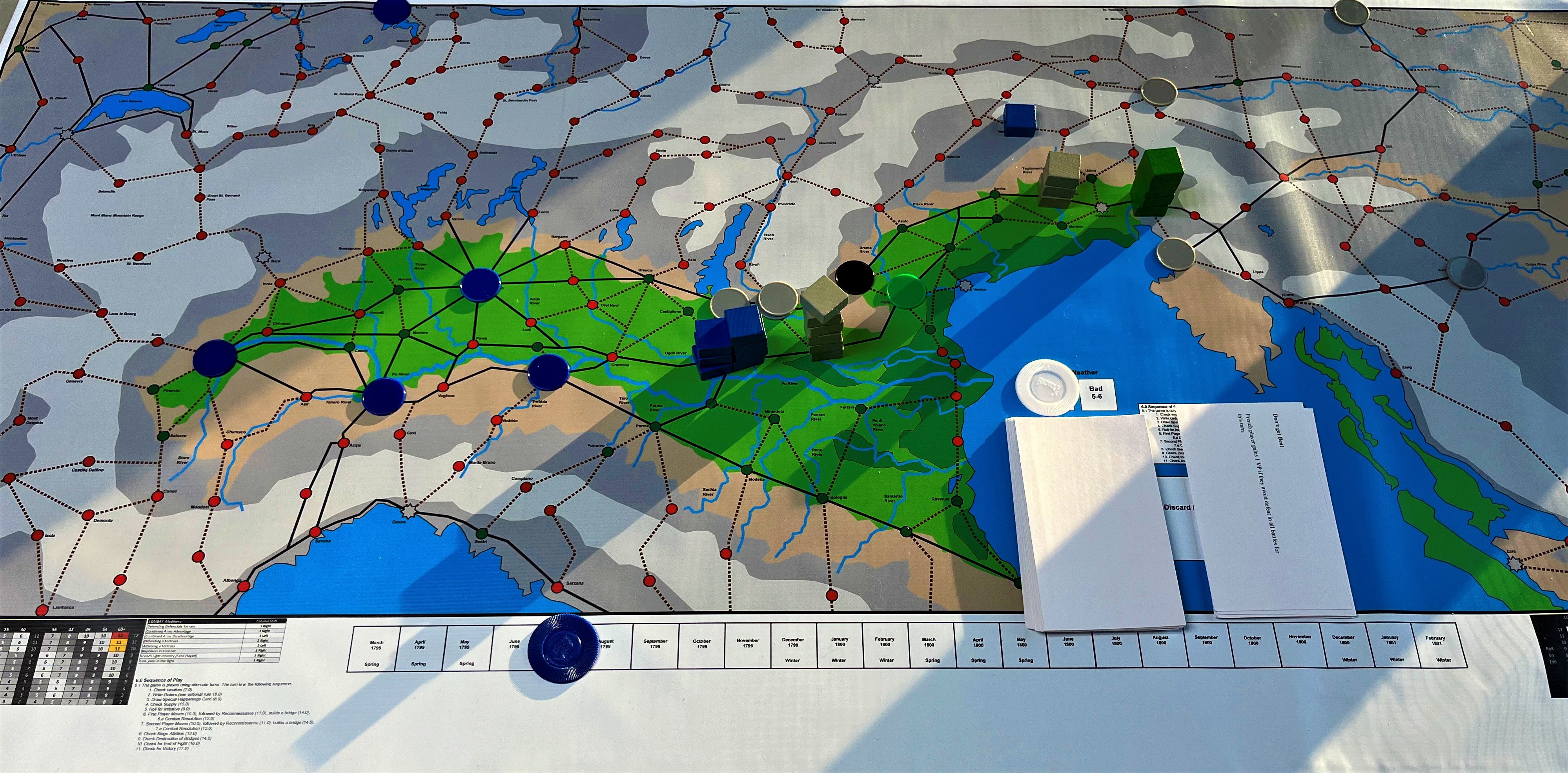
Professor Murray's map game used two maps covering the two theatres of operations in Italy and Germany. He uses this to train US staff officers. It highlights problems such as cooperation with allies, the importance of the changing political context, logistics, sieges, weather, and other aspects that don't often make it onto wargames tables. Here we see matters come to a head in the Po valley as the massed French field armies give the Austrians a bloody nose, while a small French force upper right menaces allied supply lines, dragging big Allied stacks away from the main action. BBB players may guess at the genesis of the combat results table at bottom left.

And this is the Germany map. The green stripe down the left part is the Rhine valley; the white patch along the bottom of it is the mountains of northern Switzerland. Little discs are fortress garrisons, big stacks are field armies (blue = French, grey = Austrian, green = Russian.) Not sure what happened here as I was fighting in Italy, but I think the French have repelled an aggressive Austrian incursion and wiped out an Austrian army.

Tonight's entertainment will be something different again: Seven Years War, the battle of Kolin, using the Kriegskunst rules. More on that in due course, no doubt.


Tuesday, 22 October 2019

Irish military history tourism

In a previous post on Irish battles I reported on visiting some sites of military interest in the south of Ireland: Waterford, Kinsale, Baltimore, and especially Enniscorthy (Vinegar Hill).

This year I managed to tour the northern half of the island. Highlights were:
Siege of Londonderry (1689)
Battle of the Boyne (1690)
Battle of Aughrim (1691)
HMS Caroline (1914-vintage warship in Belfast)

I don't generally do boats nor anything pre-Napoleon, so I learned a lot.

Let's talk about HMS Caroline first. A C-class light cruiser built in 1914, this is the only surviving vessel to have fought in the battle of Jutland. As a museum she is really well done: piped background noises of what the crew, machinery etc would have been doing when she was in service added atmosphere, and the exhibits and displays were suitably interesting and informative. As well as being in action in WWI, she served as a static operations HQ in the fight against the U-Boats in WWII, and then as a naval reserve training base post-war. Our tour was enhanced by getting to talk with one of the museum volunteers, John, who had actually served on her post-WWII. If you happen to be in Belfast, well worth a visit.

Londonderry
Call me ignorant (you wouldn't be the first) but I simply hadn't appreciated the pivotal importance of Northern Ireland's second largest city in the island's troubled history. The key moment was in 1689 during the Williamite War in Ireland. To contest the English crown with William III, James II landed in Ireland where he had a lot of support; his forces overran almost all of the island except Derry and Enniskillen. Fearing a repeat of the 1641 massacres, Derry shut its gates to James and underwent an epic 105-day siege in which some sources say as many as 10,000 of the defenders and inhabitants perished before finally being relieved. The city walls are intact and impressive, and the Siege Museum is excellent. Murals and memorials on either side of the city outside the walls are sobering reminders that the scars are still raw. Consequently anything I write about this risks being contentious, so let me say here I have no partisan axe to grind and I don't mean to take sides. At least I now know a lot more than I did about both the Republican and the Unionist causes.

Battle of the Boyne
Now this I had heard of! It does qualify as a bloody big battle: about 35,000+ Williamites attacking 23,000 or so Jacobites. A feint outflanking maneuver drew off a large fraction of the Jacobite army before a Williamite frontal assault forded the river, resulting in a Jacobite defeat with losses of some 1,500, twice those of the Williamites. Of course it is in the area of linear warfare, about which I have expressed my view previously. Nevertheless, while I have reservations about how exciting it might be to wargame,* it's certainly colourful to read about. The battlefield has a fine visitor centre in an 18th-century stately home. An illuminated battlefield layout does a very good job of talking you through the course of the battle. (No miniatures, sadly, just red spotlighting for Williamite positions and blue for Jacobites.) Good displays of weaponry and especially artillery. Unfortunately we didn't have time to tour all of the battlefield. Some other time, perhaps.


Battle of Aughrim
Remarkably, until planning this trip I was unaware of this, the bloodiest battle in Ireland's history. (I read a suggestion that it was the bloodiest in the British Isles, since the claims for medieval battle casualties were inflated; still, it is hard to believe that the Towton casualty list can be discounted from the commonly stated 28,000 or so to be lower than Aughrim's upper estimate of  maybe 9,000.) Coming a year after the Boyne, it is the result of William's decision to crush the Jacobite army in Ireland before further aid could come to it from France. Twenty thousand Williamites found themselves attacking an equivalent number of Jacobites in a strong position: on high ground with bog to the front, the left resting on Aughrim village and the right on a bridge. Initial Williamite assaults against the bridge and in the centre suffered bloody repulse; a subsequent assault in the north along a causeway into Aughrim might have had as little result, had a chance cannon shot not carried off the head of the Jacobites' French commander-in-chief, the Marquis de St Ruth, as he headed toward Aughrim to direct the defence there. The resulting confusion among the Jacobites enabled the Williamites to claw their way into Aughrim and then roll up the Jacobite line. This Jacobite defeat effectively ended the war.

The battlefield has a visitor centre, but unfortunately this closed for the winter as early as September. (Come on, Galway county council, keep it open a bit longer in future please!) However, the battlefield is well placarded at the key points, and I can highly recommend the app that will talk you through it. It was an easy route to drive around and we got a good sense of the scale of the battle and the nature of the ground.


===

Having seen Londonderry, the Boyne and Aughrim, then, will I start wargaming the Williamite War? You probably won't see me rushing out to buy Pendraken armies for the League of Augsburg any time soon; but at least next time I get roped into a Williamite wargame I'll have a better understanding of what I'm fighting for. And meanwhile, I've enjoyed good food and drink, good company and fine hospitality from the good people of Ireland (north and south). The sun even shone a few times when we needed it to!

===


*I have actually wargamed a Williamite battle with my mate Mike's armies. I do remember having to make one decision: whether to wait on my hill to be attacked, or to come down off it and attack with superior numbers before the enemy's flank march could arrive. I did the latter and lost. Can't recall which side I was playing though.


Friday, 28 July 2017

Modern naval Greco-Turkish: Shipwreck!

A real change of scene this week. I rarely touch moderns, and I don't really do boats, so modern naval has me, er, out of my depth. Having said that, I do possess 1980s British and Soviet fleets, and years ago I bought the Shipwreck rules to try to use them, but I'm not sure I ever played them more than once or twice, and probably solo at that.

Well, our Bruce has independently discovered Shipwreck himself, and found the time to paint up beautiful Greek and Turkish fleets plus assorted civilian vessels; and to prepare a scenario for us to get to grips with both the rules and the technology. For modern naval warfare is exceedingly complex, with so many different weapons of hugely varying capability, and the subtleties of when to switch your radar on or off, how deep to run your subs, how to reconnoitre with your helos ... it is impossible to attempt any coherent tactics without understanding all these factors.

Greeks and Turks swap Harpoons off Santorini.
This photo doesn't do Bruce's handiwork justice - it was a very pretty table.

So we amateur admirals blundered toward each other off Santorini in a simple encounter action and learned the hard way. Many missiles were launched, much chaff and many AAA rounds were dispensed, many overtaxed brain cells lightly fried. The net result of the evening was one Turkish frigate lightly damaged.

Notwithstanding our collective learning difficulties and special needs, it was an intriguing and amusing game, and as we gradually grasped what we were supposed to be doing, it was possible to see tactics evolving. I do think naval battles really need a campaign, or at least some mini-campaign pre-battle manoeuvring. Shipwreck could actually be quite rewarding for that, as campaign moves could be worked out between club meetings, individually at leisure with the time to ponder weapons and their interactions, alternative formations and tactics etc etc. I'd certainly be happy to dip my toes in the Shipwreck waters again. And Bruce does always put on a good-looking game!

===

Miscellaneous ongoing BBB stuff:
- Some of the guys fought my Isaszeg 1849 scenario and had a good time with it, and I am resuming work on the rest of the Hungary 1848-1849 set, busily translating Hungarian and researching. Next stop Komarom. Hoping to visit some of the actual battlefields before the end of this year.
- Still tinkering with our BBB WWII variant which is exciting and promising. Giving it another outing next week.
- Playtesting of Mark Smith's "Wars in India" collection (or as I like to think of it, "Bloody Big INDIAN Battles!") proceeds apace. I guess it should be ready for publication in 2018.
- Playtesting Konstantinos Travlos's Balkan Wars collection is also progressing; mostly by Konstantinos himself, but I have done some, with more scheduled for next month.