Tuesday, 18 February 2020

Raid on Suez (1915)

I only get to see my mate Anton about twice a year. When we do meet up, it is usually to fight one of the outstanding Boer War scenarios he's been very gradually compiling. With Anton, it's definitely a case of quality rather than quantity.

Since the New Year, though, he's had an uncharacteristic flurry of activity and bombarded me with several scenarios from diverse corners of history. There is another Boer War scenario in his ready-for-testing queue (Diamond Hill), but the one that took to the table this week was some early WWI action: the Ottoman raid on Suez in 1915.

 
 A lot of desert to cross! Ottomans arrive from the right,
approaching the Suez Canal left of picture.
(6mm figures from Irregular Miniatures - WWII Italians proxying for the Turks;
WWI Brits painted as Balkan Wars Greeks return to Imperial service.)

The history: an Ottoman force of some 13,000 men marched from Beersheba to the Suez Canal - about 150 miles. The Canal was guarded by 30,000 or so British Empire troops, so there was never any question of the Ottomans holding what they took. The aim was presumably more to stir up revolt against the British in Egypt. Still, with the advantage of choosing their point of attack, even though their approach march was detected, the Ottomans were able to achieve sufficient brief local superiority to get a few hundred men across. However, when Imperial reinforcements came up, the feeble Ottoman toeholds were soon eliminated. The raiders retired having suffered heavy losses.

Our game of it surprised everyone. Garry and Bruce arrived first, read the scenario, and decided the Turks had no chance so they'd play the British. David B and Dave W then turned up and fatalistically accepted their role as the doomed Ottomans. The first couple of turns confirmed everyone's prejudices as the Turks and their Arab irregulars struggled across the open ground being mown down by the intense fire from entrenched Indian troops with magazine rifles, artillery and gunboats.

Yet as the Turks doggedly pressed closer to the trenches and brought their own artillery into play, they began suppressing enough of the British fire to make it less lethal. Eventually the Ottomans managed to storm not one but two of the four British outposts on the east bank of the Canal. British reinforcements arrived: Rajputs, Australians and a couple more gunboats. The northern Ottoman force (mostly Arabs) was virtually wiped out, but its artillery deterred the Aussies from retaking Ismailia Ferry Post. In the south, the Ottoman 10th Division in the second wave had established a foothold across the Canal and could not be prized loose.

This was a remarkable turnaround in fortunes, and a result which had seemed extremely unlikely for most of the game. Hard to say whether it was down to dice or tactics (I was only watching the northern half of the table), but it was certainly entertaining. This scenario will be rolled out again, for sure.

Scenario is in the files of the BBB group on groups.io for anyone interested.


Sunday, 2 February 2020

On the virtues of IGO-UGO

I got a ton of gaming in in January - not spread out as a game a week as usual, but packed into a four-day long weekend. At the foot of this post is just a brief report for the record. As well as providing good gaming, the weekend also prompted me to pontificate on the virtues of traditional 'IGO-UGO' rulesets.


By 'IGO-UGO' I mean games where basically all units on one side take their actions for a given phase, then all the units on the other side do so. A typical IGO-UGO sequence of play could be:

French units move
British units fire
French units check morale
French units resolve charges

British units move
French units fire
British units check morale
British units resolve charges

There are plenty of criticisms that can be made of this 'traditional' sequence. Real battles aren't like that; it's too predictable; it's not exciting enough; it doesn't capture the ebb and flow, the tempo, the shifts in initiative, etc. Consequently many rulesets now use more fluid, less mechanical turn sequences. These may be card-driven, or use clever bidding systems to see which units get to move first, or have variable points to allocate and ways to interrupt the enemy's actions.

Such non-traditional systems have many virtues. By forcing players to concentrate their efforts and attention where they matter most, they may produce more realistic battles with complete lulls on a less important sector. They can produce cinematic excitement as everyone follows the action. Unpredictability may keep players on their toes and encourage realistic behaviour - maintaining reserves, setting up units on overwatch. Bidding systems can generate a battle of wits and bluff that can be entertaining in its own right.

Unfortunately, on occasion all these virtues are outweighed by one major vice: in multi-player games, I don't get to spend enough time actually playing.

Life is short. I get much of my wargaming pleasure from making plans and implementing them through my tactical decisions on the tabletop. Watching other people implement theirs is also interesting, but I never go to the club just to watch. But that's what some of these systems make me do.

Look at it this way. Say there are six of us in a Napoleonics game; for the sake of argument, make it three French and three British. With an IGO-UGO ruleset that lets all three of us Brits move at once, I am getting to play 50% of the time; knock it down a bit to 40% because one of my fellow players will usually take a bit longer to do his moves. Then there's 50% of the time when all the French are moving, including my opponent on my particular sector of the table; knock that down to 40% as well, since he will usually finish before one of his comrades. Let's give an arbitrary half-value to time spent watching my direct opponent, and quarter-value to time spent sitting around watching less relevant action. I calculate that gives me my own 40%, +20% for my oppo's actions, plus just 5% for what everyone else is doing = 65% of the time I am engaged in the game.

Now let's translate that to some non-IGO-UGO system where just one player activates one unit at any one time. (I remember one grim evening of Saga - in itself a brilliantly innovative system and great for one-to-one games - but absolutely dire for a six-player game of Stamford Bridge.) With a sixth of the units, I get a sixth of the action: 17%. My oppo gets his sixth, which at half-value is worth 8% to me. The other two thirds of the time, at quarter value, is worth 17%. Total 17+8+17 = 42%.

We could argue about whether watching other players is more or less than quarter or half as interesting as pushing my own troops across the pitch. The exact numbers don't matter so much as the general point that when multiple players get to act simultaneously, I find it significantly more engaging, and feel I get better gaming value, than when we all have to watch the one person whose card just came up. I don't think I'm alone - during some of the games in our gamefest, there were guys spending more time on their phones than actually gaming.

I'll throw in another point in favour of the multiple simultaneous actions allowed by mass IGO-UGO: it can actually generate more realistic command dislocation. By that I mean, with a 'follow-the-action' game, where everyone is looking at everything that happens (provided they're not checking emails or playing Candy Crush), developing and maintaining a coherent and consistent centrally-directed plan is relatively easy. If everyone gets to act simultaneously, and people are more engaged and absorbed in the action on their own sectors, you can get more realistic results in the sense that real commanders likewise often focused on what was in front of them, to the detriment of the bigger picture.

Hence my personal preference for rulesets that allow simultaneous action. I know others feel differently. I have enjoyed many good games with 'cinematic' rulesets. However, I feel that four players is the limit for such games, and beyond that I don't get enough share of the action.


January gamefest

Because of cancellations and overruns we had to drop a couple of games from the schedule, unfortunately (Finnish Winter War air battles, and a Pacific War strategy game). Still we got these six in, plus movies (T34, and Panfilov's 28), plus much camaraderie and banter:

Cole's Charge, Carentan 1944 (Battlegroup WWII rules)
Another Carentan 1944 game - road to Baupte? (BG)
Battle of the Bulge 1944 (BG)
Spotsylvania ACW 1864 (BBB)
Jumonville Glen FIW 1754 (Muskets & Tomahawks)
Hannut 1940 (Breakthrough)

That's enough WWII skirmish gaming to last me all year! But I enjoyed the tactical challenges, especially the Bulge game trying to hold off overwhelming numbers of Yanks with a few Panzergrenadiers and Panthers handicapped by fog and lack of fuel. Always a pleasure to run the ACW BBB games, though sadly this time it was a daytime game rather than evening so there was less atmosphere of bourbon-fuelled revelry than normal. As George Washington, I let Jumonville off the hook somewhat as he himself got away, but most of his command didn't. Hannut was a really interesting fight that I'd never really studied. Good to see all that 1940 armour trundling around on the table, and I managed to give the Panzers a bloody nose. Hope to fight that one again some time.

Thursday, 23 January 2020

Gurkha Christmas special!

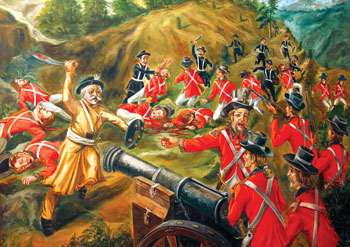
For the sixth year running, Mark continued his splendid tradition of running a Christmas special BBB game for us. His theme this time was the Gurkha War of 1814-1816.

Anglo-Nepal war.jpg
Ayo Gorkhali!

The format was his tried and tested one: we had three or four players a side, competing not only to see which side won overall, but also which individual player on each side could achieve the most of his personal objectives - which of course conflicted to some degree with those of his team-mates.

Our action was the battle of Jaithak. Historically, two British columns tried marching up two ridges at each end of a mountain with a Nepalese fort on the top, and were bloodily repulsed. Our game emphatically reproduced this bloody repulse.

It fell to me to play Bal Bahadur on the Gurkha right. My personal objectives included holding the Nauni hilltop on our right, capturing British supply columns, but especially defeating their ally Krishna Singh. My fellow Gurkha sub-commanders Jaspao Thapa and Ujumba Punt were mainly focused on holding ground and/or preserving their forces, while our CinC Ranjoh Singh Thapa (Jaspao's big brother) was all about the central fort, wells and supplies.

For the British, CinC Martindell needed to protect his own base and preserve his core of regulars while taking part of the Gurkha position. Major Richards leading the right column and Major Ludlow on the left were rivals, wanting to take several locations, and losing points if the other won the race. Their ally Krishna Singh on their extreme left had to make a show of strength by taking locations, hurting the Gurkha army and preserving half of his own rabble.

Nothing really went right for the British. They were surprised by the arrival of Gurkha forces on their right flank and especially by most of mine turning up actually behind their left. This was a bold choice by me which could have gone wrong, had the enemy's dice been kinder. As it was, they were consistently dire, so the opportunities the British had to trap my troops in enveloping assaults or to mow them down with enfilading volleys were lost. I was therefore able to wreck several of Ludlow's and Krishna's units and take a supply column, while with Ujumba's help I repelled Krishna from Nauni hill. My counterpart Jaspao on our left likewise drove back Richards's column.

The net result was a clear win for the Gurkha side. I thought I had done rather well, but it turned out that our collective defence of our positions plus my capture of the supplies added up to a personal victory for our CinC; while despite the beating I gave Krishna, he had still managed to do least worst by comparison with the three Brits, so was the individual winner for the losing side!

As ever, it was a joy to have Mark educate us about a forgotten corner of history. (I knew the war had happened, but that was about it.) The festivities were enhanced as usual by having to pull Christmas crackers to resolve certain events during the game. A fine end to another fine year's gaming.

Previous Christmas specials:
Khoosh-Ab (1857)
Amoaful (1874)
Java (1811)
Caucasus (1845)
The first one Mark ran was Magdala (1868) but sadly I don't have a record of that.