I got a ton of gaming in in January - not spread out as a game a week as usual, but packed into a four-day long weekend. At the foot of this post is just a brief report for the record. As well as providing good gaming, the weekend also prompted me to pontificate on the virtues of traditional 'IGO-UGO' rulesets.
By 'IGO-UGO' I mean games where basically all units on one side take their actions for a given phase, then all the units on the other side do so. A typical IGO-UGO sequence of play could be:
French units move
British units fire
French units check morale
French units resolve charges
British units move
French units fire
British units check morale
British units resolve charges
There are plenty of criticisms that can be made of this 'traditional' sequence. Real battles aren't like that; it's too predictable; it's not exciting enough; it doesn't capture the ebb and flow, the tempo, the shifts in initiative, etc. Consequently many rulesets now use more fluid, less mechanical turn sequences. These may be card-driven, or use clever bidding systems to see which units get to move first, or have variable points to allocate and ways to interrupt the enemy's actions.
Such non-traditional systems have many virtues. By forcing players to concentrate their efforts and attention where they matter most, they may produce more realistic battles with complete lulls on a less important sector. They can produce cinematic excitement as everyone follows the action. Unpredictability may keep players on their toes and encourage realistic behaviour - maintaining reserves, setting up units on overwatch. Bidding systems can generate a battle of wits and bluff that can be entertaining in its own right.
Unfortunately, on occasion all these virtues are outweighed by one major vice: in multi-player games, I don't get to spend enough time actually playing.
Life is short. I get much of my wargaming pleasure from making plans and implementing them through my tactical decisions on the tabletop. Watching other people implement theirs is also interesting, but I never go to the club just to watch. But that's what some of these systems make me do.
Look at it this way. Say there are six of us in a Napoleonics game; for the sake of argument, make it three French and three British. With an IGO-UGO ruleset that lets all three of us Brits move at once, I am getting to play 50% of the time; knock it down a bit to 40% because one of my fellow players will usually take a bit longer to do his moves. Then there's 50% of the time when all the French are moving, including my opponent on my particular sector of the table; knock that down to 40% as well, since he will usually finish before one of his comrades. Let's give an arbitrary half-value to time spent watching my direct opponent, and quarter-value to time spent sitting around watching less relevant action. I calculate that gives me my own 40%, +20% for my oppo's actions, plus just 5% for what everyone else is doing = 65% of the time I am engaged in the game.
Now let's translate that to some non-IGO-UGO system where just one player activates one unit at any one time. (I remember one grim evening of Saga - in itself a brilliantly innovative system and great for one-to-one games - but absolutely dire for a six-player game of Stamford Bridge.) With a sixth of the units, I get a sixth of the action: 17%. My oppo gets his sixth, which at half-value is worth 8% to me. The other two thirds of the time, at quarter value, is worth 17%. Total 17+8+17 = 42%.
We could argue about whether watching other players is more or less than quarter or half as interesting as pushing my own troops across the pitch. The exact numbers don't matter so much as the general point that when multiple players get to act simultaneously, I find it significantly more engaging, and feel I get better gaming value, than when we all have to watch the one person whose card just came up. I don't think I'm alone - during some of the games in our gamefest, there were guys spending more time on their phones than actually gaming.
I'll throw in another point in favour of the multiple simultaneous actions allowed by mass IGO-UGO: it can actually generate more realistic command dislocation. By that I mean, with a 'follow-the-action' game, where everyone is looking at everything that happens (provided they're not checking emails or playing Candy Crush), developing and maintaining a coherent and consistent centrally-directed plan is relatively easy. If everyone gets to act simultaneously, and people are more engaged and absorbed in the action on their own sectors, you can get more realistic results in the sense that real commanders likewise often focused on what was in front of them, to the detriment of the bigger picture.
Hence my personal preference for rulesets that allow simultaneous action. I know others feel differently. I have enjoyed many good games with 'cinematic' rulesets. However, I feel that four players is the limit for such games, and beyond that I don't get enough share of the action.
January gamefest
Because of cancellations and overruns we had to drop a couple of games from the schedule, unfortunately (Finnish Winter War air battles, and a Pacific War strategy game). Still we got these six in, plus movies (T34, and Panfilov's 28), plus much camaraderie and banter:
Cole's Charge, Carentan 1944 (Battlegroup WWII rules)
Another Carentan 1944 game - road to Baupte? (BG)
Battle of the Bulge 1944 (BG)
Spotsylvania ACW 1864 (BBB)
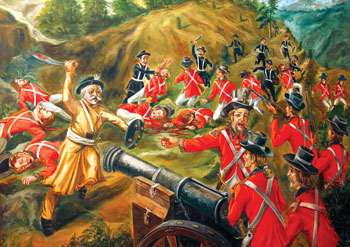
Jumonville Glen FIW 1754 (Muskets & Tomahawks)
Hannut 1940 (Breakthrough)
That's enough WWII skirmish gaming to last me all year! But I enjoyed the tactical challenges, especially the Bulge game trying to hold off overwhelming numbers of Yanks with a few Panzergrenadiers and Panthers handicapped by fog and lack of fuel. Always a pleasure to run the ACW BBB games, though sadly this time it was a daytime game rather than evening so there was less atmosphere of bourbon-fuelled revelry than normal. As George Washington, I let Jumonville off the hook somewhat as he himself got away, but most of his command didn't. Hannut was a really interesting fight that I'd never really studied. Good to see all that 1940 armour trundling around on the table, and I managed to give the Panzers a bloody nose. Hope to fight that one again some time.
By 'IGO-UGO' I mean games where basically all units on one side take their actions for a given phase, then all the units on the other side do so. A typical IGO-UGO sequence of play could be:
French units move
British units fire
French units check morale
French units resolve charges
British units move
French units fire
British units check morale
British units resolve charges
There are plenty of criticisms that can be made of this 'traditional' sequence. Real battles aren't like that; it's too predictable; it's not exciting enough; it doesn't capture the ebb and flow, the tempo, the shifts in initiative, etc. Consequently many rulesets now use more fluid, less mechanical turn sequences. These may be card-driven, or use clever bidding systems to see which units get to move first, or have variable points to allocate and ways to interrupt the enemy's actions.
Such non-traditional systems have many virtues. By forcing players to concentrate their efforts and attention where they matter most, they may produce more realistic battles with complete lulls on a less important sector. They can produce cinematic excitement as everyone follows the action. Unpredictability may keep players on their toes and encourage realistic behaviour - maintaining reserves, setting up units on overwatch. Bidding systems can generate a battle of wits and bluff that can be entertaining in its own right.
Unfortunately, on occasion all these virtues are outweighed by one major vice: in multi-player games, I don't get to spend enough time actually playing.
Life is short. I get much of my wargaming pleasure from making plans and implementing them through my tactical decisions on the tabletop. Watching other people implement theirs is also interesting, but I never go to the club just to watch. But that's what some of these systems make me do.
Look at it this way. Say there are six of us in a Napoleonics game; for the sake of argument, make it three French and three British. With an IGO-UGO ruleset that lets all three of us Brits move at once, I am getting to play 50% of the time; knock it down a bit to 40% because one of my fellow players will usually take a bit longer to do his moves. Then there's 50% of the time when all the French are moving, including my opponent on my particular sector of the table; knock that down to 40% as well, since he will usually finish before one of his comrades. Let's give an arbitrary half-value to time spent watching my direct opponent, and quarter-value to time spent sitting around watching less relevant action. I calculate that gives me my own 40%, +20% for my oppo's actions, plus just 5% for what everyone else is doing = 65% of the time I am engaged in the game.
Now let's translate that to some non-IGO-UGO system where just one player activates one unit at any one time. (I remember one grim evening of Saga - in itself a brilliantly innovative system and great for one-to-one games - but absolutely dire for a six-player game of Stamford Bridge.) With a sixth of the units, I get a sixth of the action: 17%. My oppo gets his sixth, which at half-value is worth 8% to me. The other two thirds of the time, at quarter value, is worth 17%. Total 17+8+17 = 42%.
We could argue about whether watching other players is more or less than quarter or half as interesting as pushing my own troops across the pitch. The exact numbers don't matter so much as the general point that when multiple players get to act simultaneously, I find it significantly more engaging, and feel I get better gaming value, than when we all have to watch the one person whose card just came up. I don't think I'm alone - during some of the games in our gamefest, there were guys spending more time on their phones than actually gaming.
I'll throw in another point in favour of the multiple simultaneous actions allowed by mass IGO-UGO: it can actually generate more realistic command dislocation. By that I mean, with a 'follow-the-action' game, where everyone is looking at everything that happens (provided they're not checking emails or playing Candy Crush), developing and maintaining a coherent and consistent centrally-directed plan is relatively easy. If everyone gets to act simultaneously, and people are more engaged and absorbed in the action on their own sectors, you can get more realistic results in the sense that real commanders likewise often focused on what was in front of them, to the detriment of the bigger picture.
Hence my personal preference for rulesets that allow simultaneous action. I know others feel differently. I have enjoyed many good games with 'cinematic' rulesets. However, I feel that four players is the limit for such games, and beyond that I don't get enough share of the action.
January gamefest
Because of cancellations and overruns we had to drop a couple of games from the schedule, unfortunately (Finnish Winter War air battles, and a Pacific War strategy game). Still we got these six in, plus movies (T34, and Panfilov's 28), plus much camaraderie and banter:
Cole's Charge, Carentan 1944 (Battlegroup WWII rules)
Another Carentan 1944 game - road to Baupte? (BG)
Battle of the Bulge 1944 (BG)
Spotsylvania ACW 1864 (BBB)
Jumonville Glen FIW 1754 (Muskets & Tomahawks)
Hannut 1940 (Breakthrough)
That's enough WWII skirmish gaming to last me all year! But I enjoyed the tactical challenges, especially the Bulge game trying to hold off overwhelming numbers of Yanks with a few Panzergrenadiers and Panthers handicapped by fog and lack of fuel. Always a pleasure to run the ACW BBB games, though sadly this time it was a daytime game rather than evening so there was less atmosphere of bourbon-fuelled revelry than normal. As George Washington, I let Jumonville off the hook somewhat as he himself got away, but most of his command didn't. Hannut was a really interesting fight that I'd never really studied. Good to see all that 1940 armour trundling around on the table, and I managed to give the Panzers a bloody nose. Hope to fight that one again some time.